

Many charter school leaders describe their first year the same way. Everything felt urgent, and it wasn’t always easy to tell what needed attention right away and what could wait. Schools further along in their journey often describe their growing pains the same way.
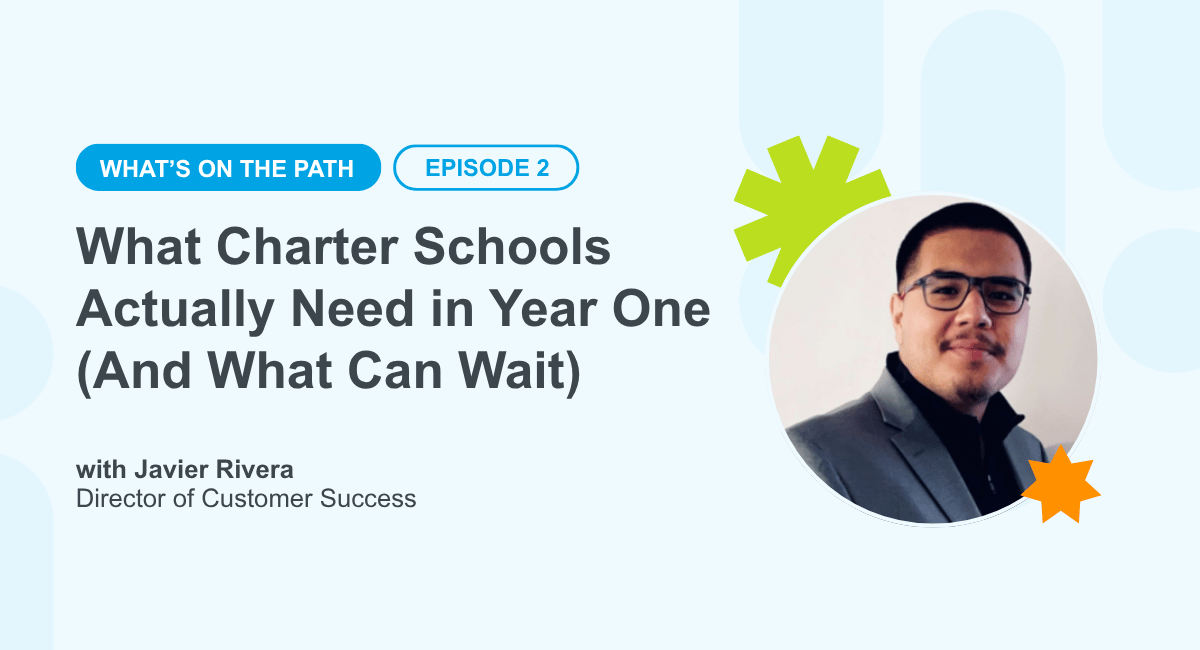
The second episode of What’s on the Path takes up that question directly, with School Pathways’ Director of Customer Success, Javier Rivera, sharing what he’s learned from working with hundreds of charter schools through their first year and beyond. Before moving into customer success, Javier spent years inside charter school operations, where he handled enrollment, compliance, attendance, and CALPADS reporting, so this conversation reflects the same pressures many charter leaders are navigating today.
Here’s what matters most when it comes to building charter school operations that hold up as a school grows.
Clear Roles Set the Foundation for a Strong Year One
The charter schools that get off to a strong start in year one aren’t necessarily the ones with the biggest budgets or the largest teams. What sets them apart is clarity: someone owns enrollment, someone owns document review, someone owns attendance, and someone owns archiving student records. When responsibilities have owners, staff know where to turn and what’s expected of them.
Just as important is staying curious during implementation. Asking why a system is set up a certain way, rather than simply learning which buttons to press, leads to better decisions later. Understanding the reasoning behind a workflow gives a school room to adapt it as things change.
Ask What a Process Is For Before You Digitize It
One common pattern that often shows up is a new charter school trying to recreate a previous school’s or district’s processes exactly as they were. It’s an understandable instinct; familiar processes feel safe. But without asking what problem a process was actually solving, schools risk carrying over old inefficiencies into a brand-new or unique system.
Attendance is a good example. Whether a school claims attendance once a day, for every period, or during homeroom isn’t just a preference; that decision also affects compliance, teacher work law, reporting, and funding. It helps to slow down and understand how a decision ripples across other processes before locking it in. The same is true for smaller configurations, such as signature dates on Learning or Master Agreements, where an intentional setup choice can save hours of manual review each month.
Protecting Institutional Knowledge as Your Team Grows
A warning sign to watch out for is when the knowledge needed to run daily operations lives in just one person’s head. A registrar or operations director with that kind of undocumented knowledge is also often unknowingly posing a real risk to the school. If that person leaves, the school doesn’t just lose a colleague, but also the process itself.
Build in documentation and cross-training early, before a departure forces the issue. When knowledge is shared across a team in living documentation, processes survive transitions rather than needing to be rebuilt retroactively.
What Changes When a School Grows From 300 Students to 1,000
Growth doesn’t just mean more of the same. A school moving from a few hundred students to a few thousand faces a different set of challenges: a heavier document-review workload, greater pressure on teaching staff capacity, and budget assumptions that need to be checked against actual numbers rather than projections.
Revenue tends to lag behind growth, since funding is often realized the following year. That means schools need to be ready to front costs and make hard staffing or space decisions early if enrollment doesn’t land where they expected. Keep a close eye on Average Daily Attendance throughout the year rather than waiting for a year-end surprise, so there’s time to adjust before a shortfall becomes a bigger problem.
Starting Small: Enrollment and Attendance Come First
For schools just getting started, with a small team and a long list of things to build, it’s tempting to try to stand up every feature at once. A simpler approach works better. Get students enrolled first, and keep attendance compliant before anything else. Schools that put clear staff procedures, documented enrollment, and reliable attendance tracking in place first tend to have an easier time building on top of them later.
Before evaluating a new SIS, it can help to have a resource on hand. School Pathways’ charter founder SIS checklist walks through the questions worth asking as you look for the right fit for your school.
The Path Forward
The same principle holds for a school in its first year and a school on its fourth site. A foundation that’s documented, understood, and shaped around how the school actually operates, rather than borrowed from a standard template, tends to make growth feel manageable.
Javier’s perspective holds true for many establishing institutions: Today’s decisions can affect long-term operational success, whether in 6 months or several years. That’s why sustainable growth takes planning.
Looking ahead, School Pathways is investing heavily in AI enhancements to take repetitive administrative work off staff’s plates, alongside continued improvements to existing products and the overall user experience. We believe technology should play a supporting role to free up time and create clarity so educators can better serve students and families for years to come, rather than being an end in itself.
If you’d like to talk through what a trusted partnership and a better-built system, configured to your operations, could look like for your school, we’d love to connect.