

The conversation around AI in education is moving fast, and many schools are feeling pressure to keep up amid rapidly changing policies, an influx of new tools, and growing expectations to define a clear AI strategy.
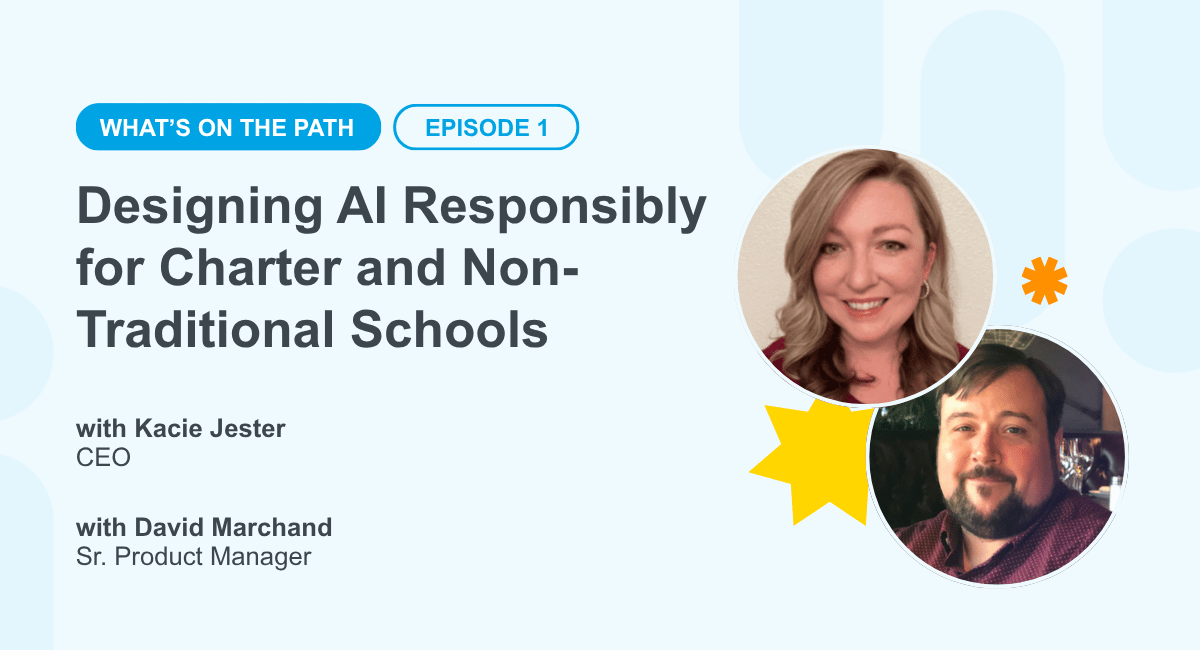
In the first episode of What’s on the Path, School Pathways CEO Kacie Jester and Senior Product Manager David Marchand sat down to talk through what designing AI responsibly looks like for charter and non-traditional schools.
Here’s what matters most when it comes to adopting AI thoughtfully:
AI Should Reduce Burden, Not Add to It
Charter schools and flex-based programs already operate with a level of complexity that traditional schools don’t face. Individualized pacing, Independent Study requirements, work and learning records, and varied compliance reporting are all part of the day-to-day. The administrative load is considerable, and it’s often what pulls educators away from the work they actually care about.
When AI is introduced into that environment, the question worth asking is whether it effectively improves what educators are already doing. If a tool doesn’t reduce clicks, save time, or clarify a decision, it likely isn’t worth the effort of a rollout. Schools that approach AI adoption with that lens make better choices and avoid adding complexity in the name of modernizing.
Near-Term Value vs. Long-Term Vision
There’s a useful distinction between what AI can do for schools today and what becomes possible over time with the right foundation in place.
Right now, the most realistic applications are simplifying compliance workflows, reducing reporting errors, and saving staff time on repetitive tasks, especially in complex flex-based operations. While these may not be the most high-profile use cases, they’re high-impact for schools where staff wear many hats and compliance pressure is constant.
In the long term, the opportunity is in unified data intelligence. When attendance, pacing, interventions, and performance data are connected in a single system, AI can surface patterns that people don’t always have the bandwidth to spot manually. Earlier interventions, more proactive student support, and better audit readiness are made possible when the foundational infrastructure is solid, which is why it’s critical to build carefully from the start.
Student Data Protection Is the Starting Point
Any school evaluating AI tools should treat data protection as a baseline expectation, not a differentiator. FERPA compliance is non-negotiable. Schools should also look for vendors who minimize data exposure wherever possible, use anonymization, maintain strict agreements for model training, and are fully transparent about how AI interacts with school data.
If a vendor can’t clearly explain what data is being used and how, that’s worth paying attention to. AI tools in schools should never feel like black boxes. School leaders should be able to clearly understand what’s happening inside the systems they adopt, and good partners should invite those questions rather than deflect them.
Trust Is Earned Through Transparency and Partnership
Technology partnerships in education work best when they’re built on consistent communication, not just contracts. Schools need to understand how every new tool works, what guardrails are in place, and how data is being protected. That understanding should be part of the baseline experience.
For schools still building their AI literacy, that transparency also means having vendors who provide ongoing guidance, not just the product. That support should carry through every interaction, from executive conversations, product discussions, events, and ongoing touchpoints, to help schools build confidence as they go.
A Practical Starting Point for Schools
For schools early in their AI journey, the most helpful first step is often the simplest: look at your current tech stack. Understand what your staff is already spending time on, where the biggest pain points are, and where tools might already be overlapping. Solving for the core problem tends to lead to better tool choices than starting with the technology and working backward.
It’s also wise to stay close to your existing vendors. Many of them are actively building AI into the systems you already use, which means the experience they have with your school’s operational complexity comes along with the new capabilities. AI embedded in a workflow your team already knows delivers far more value than a standalone tool sitting next to it.
The Path Forward
At School Pathways, our goal has always been to help charter and non-traditional schools manage the unique complexity they carry so educators can stay focused on students. AI should be a natural extension of that work. We’re building toward a system that can surface meaningful insights across attendance, academics, and compliance, and that feels less like a software platform and more like a capable, reliable member of your team.
We’re sharing more about where we’re headed and inviting schools to be part of that conversation. If you want to see what’s new at School Pathways or explore how this looks in practice for your school, we’d love to connect.